
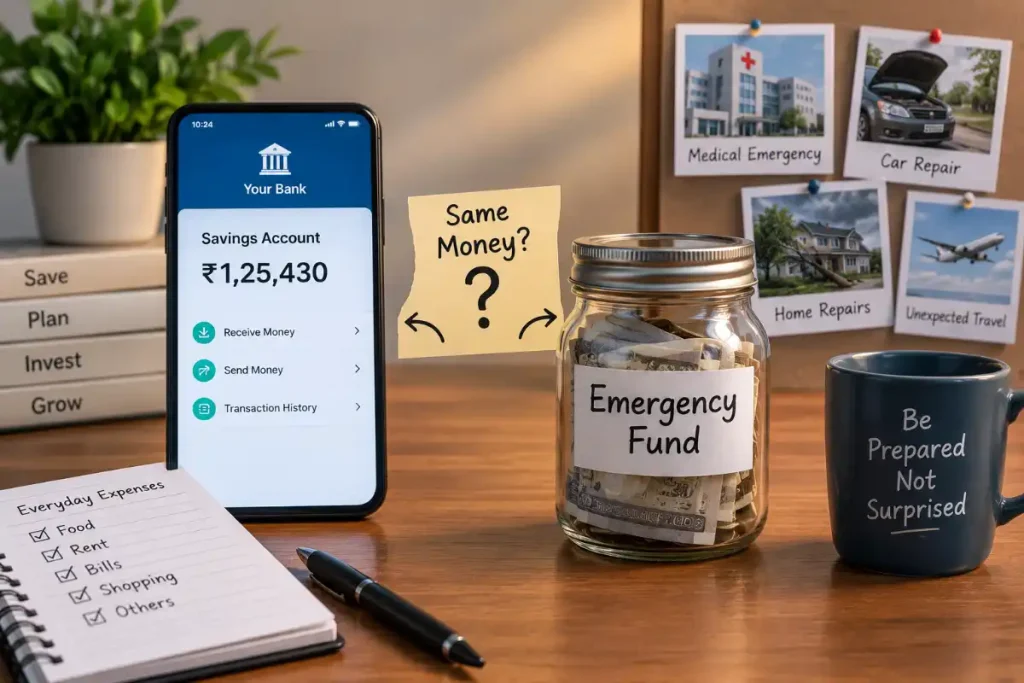
Most of us have a bank account labeled “Emergency Fund.” It feels good to see that money sitting there. You might think that as long as the balance is high, you are safe from life’s surprises. But having money in a bank account is not the same thing as having a true, functional emergency fund.
If you have to think twice about whether to use that money for a new phone or a weekend trip, you might be confusing a regular savings goal with an actual safety net. Let’s look at why your current setup might be failing you and how to fix it before a real crisis hits.
The Difference Between Saving and Protecting
A savings account is a place to park cash for things you plan to buy. Maybe you are saving for a new couch, a vacation, or a down payment on a car. This is money meant to be spent. You feel happy when you reach your goal because you get to enjoy the purchase.
An emergency fund is the exact opposite. It is money you hope you never have to touch. It is your financial insurance policy against job loss, medical bills, or major car repairs. If you are using this money to cover monthly spending or “fun” goals, you do not actually have an emergency fund. You just have a pile of money that is waiting to be spent on the wrong things.
Why Psychology Matters More Than Math
The math of money is easy. You put money in, and it stays there. But the psychology of money is much harder. We often tell ourselves that we will “pay ourselves back” if we dip into our emergency stash. We promise that it is just a temporary loan.
The problem is that real emergencies do not wait for you to save that money back up. If you spend your safety net on a luxury item and an expensive car repair happens the next week, you are in trouble. You might be forced to use a high-interest credit card, which creates a whole new problem. You can check out The Hidden Cost of Lifestyle Creep and How to Stop It to see how small spending habits often drain accounts meant for bigger priorities.
Three Signs You Are Doing It Wrong
It is easy to lie to ourselves about our finances. Look for these three warning signs to see if your emergency fund is truly secure.
- You have used your “emergency” money for holiday gifts or travel in the last year.
- You check that account when you are deciding if you can afford a non-essential purchase.
- You have no clear definition of what actually counts as an emergency.
If you said yes to any of these, your fund is not a safety net. It is just a secondary spending account. To fix this, you should keep your emergency money in a separate bank that is not linked to your daily debit card. This small barrier makes it harder to transfer money in a moment of weakness.
Defining What Counts as an Emergency
One reason people struggle to keep their funds intact is that they do not have rules. If you do not define an emergency, anything can become one. You might justify buying a new computer because your old one is “slow.” Is that an emergency? Usually, no. It is a maintenance cost.
Write down a list of what you will allow yourself to use the money for. Your list should only include things that threaten your ability to live or work. Examples include:
- Sudden job loss.
- Unforeseen medical or dental procedures not covered by insurance.
- Critical home repairs, like a broken water pipe or a leaking roof.
- Emergency travel for family matters.
If the situation does not fit on your list, it is not an emergency. It is a budget item. If you need a new computer, start a separate savings goal for it. Do not steal from your future self to fund your present wants.
How Much Do You Really Need?
There is a common rule that you should save three to six months of expenses. That is a great goal, but it can feel overwhelming when you are just starting. If you have nothing, even one month of expenses is a massive victory. You can use BestPicky Finance Tools , EMI, Loan & Investment Calculators to figure out exactly how much your monthly basic expenses cost.
Calculate the bare minimum you need to survive. Rent, utilities, food, and basic transport. Ignore gym memberships, streaming services, and dining out for this calculation. Your emergency fund is meant for survival, not for maintaining your current lifestyle in every detail.
The Benefit of Keeping It Boring
Some people get tempted to invest their emergency fund to get higher returns. They put it into stocks or volatile assets. This is a major mistake. If the market drops by twenty percent, your emergency fund shrinks exactly when you might need it most.
Keep this money in a high-yield savings account. It is boring. It will not make you rich. But it will be there when you need it. The purpose of this money is to provide peace of mind, not growth. When you treat your money with this level of respect, you stop looking at it as a slush fund and start seeing it as your wall of defense.
Take Control of Your Safety
Start today by separating your money. Open a new savings account at a different bank. Move your emergency cash there. Tell yourself that this money is strictly for disasters. When you create this physical distance, you change your relationship with the cash.
If you find that you keep tapping into your reserves, your problem might not be your savings strategy. It might be your monthly budget. You might be living too close to your income limit, leaving no room for the unexpected. Build your fund slowly, stick to your rules, and keep the money somewhere you cannot see it every single day.
What if I have debt?
Many experts suggest having a small starter fund of one month of expenses before attacking debt. Once that safety net is in place, you can focus on paying off high-interest loans. Do not skip the safety net, or you will likely end up back in debt when the first car repair bill arrives.
Should I include my spouse’s money?
Yes, if you share finances. A household emergency fund should cover the total expenses for the entire home. Ensure you both agree on what constitutes a real emergency so that you do not accidentally spend the fund on things that are not actually critical.
What if inflation eats away at the value?
It is true that cash loses some value to inflation over time. However, the cost of not having an emergency fund, which often leads to high-interest credit card debt, is much higher than the small amount lost to inflation. Prioritize safety over investment growth for this specific bucket of money.
Want to Calculate Your SIP?

Click the button above and check your expected SIP returns instantly.