
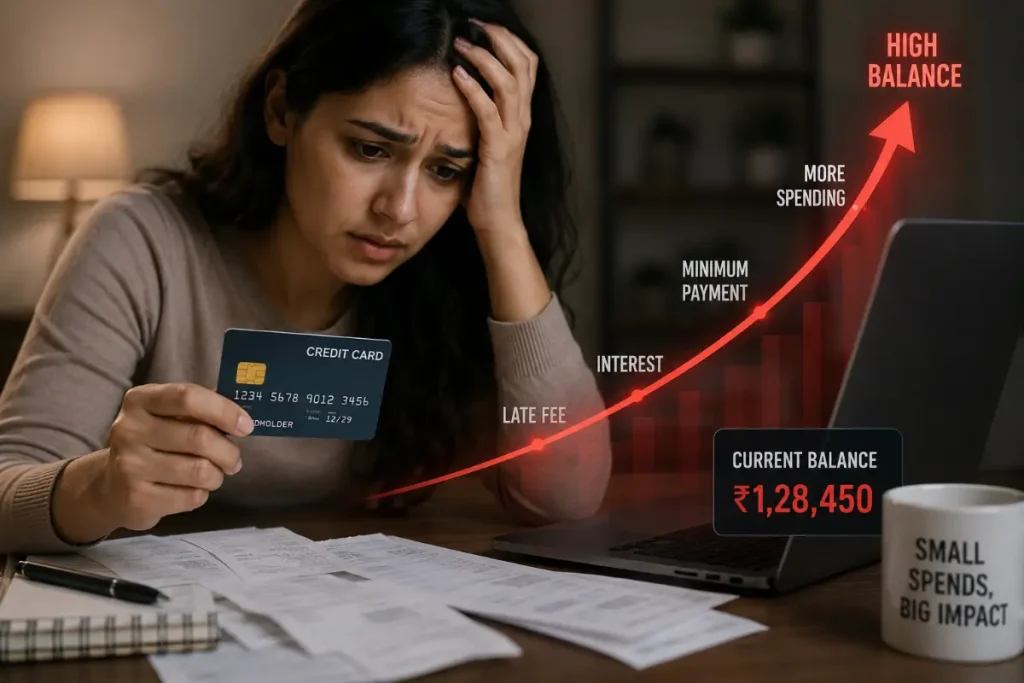
Most of us treat a credit card like a magical tool. You swipe it, you get the item, and you pay for it later. It feels harmless because the money does not leave your bank account immediately. This mental trick is exactly why banks love credit cards so much. They know that when you do not see the cash vanish, you are much more likely to spend more than you actually have.
The real trouble starts when you only pay the minimum amount due each month. You might look at your statement and think that paying a small fee keeps you safe. In reality, you are setting a trap for your future self. That small balance is about to become a heavy anchor that stays with you for years.
How the Math Works Against You
Credit card interest works differently than the interest on a car loan or a mortgage. Most loans have a set timeline. You know exactly when the debt will be gone. A credit card is what experts call a revolving line of credit. It never ends unless you force it to end.
When you carry a balance, the bank adds interest to what you owe every single day. This is called daily compounding. If you owe one thousand dollars at a typical interest rate of 20 percent, you are not just paying back that one thousand dollars. You are paying for the privilege of borrowing that money, and that cost grows every time you fail to pay the full balance.
Let us look at a simple example. Suppose you buy a new laptop for one thousand dollars. If you decide to pay only the minimum required payment, the math looks grim. Because the interest is added to your total debt, your next payment covers mostly interest and very little of the original cost. You could end up paying double or triple the original price of that laptop over five years. By the time you are finished, the laptop will be old and slow, but you will still be paying for it.
The Hidden Cost of Minimum Payments
Banks often print the minimum payment at the bottom of your statement in big, bold letters. It looks like a friendly suggestion. It makes the debt look manageable. They do this because they want you to keep the debt alive. If you pay the full amount, they stop making money from your interest charges. If you pay the minimum, they earn a profit from you for months or even years.
You can use our BestPicky Finance Tools , EMI, Loan & Investment Calculators to see how long it takes to clear a balance based on different payment amounts. You will likely find that adding just fifty dollars to your minimum payment can cut your repayment time by more than half. It is a simple shift that changes your entire financial future.
Why We Overspend with Plastic
Psychology plays a huge role in how we use credit. When you hand over physical cash, your brain feels a slight sense of pain. You see your wallet getting thinner. This acts as a natural brake on your spending. When you swipe a card or tap your phone, that feeling disappears. The purchase feels like it is free for the moment.
This is known as the payment decoupling effect. Your brain separates the joy of the purchase from the pain of the payment. Credit card companies use this to their advantage. They offer points, rewards, and cashback to make the card feel like a benefit rather than a tool for borrowing money.
Three Steps to Stop the Cycle
You do not need to cut up your cards to stay safe, but you do need to change how you handle them. If you cannot pay the full balance, you are effectively buying everything at a massive discount for the store, but paying a huge tax to the bank.
- Track your spending in real time. Do not wait for the paper bill at the end of the month. Use your banking app to see exactly how much you have spent this week.
- Treat your credit card like a debit card. Only spend money that you already have in your checking account. If the money is not there, do not make the purchase.
- Set up automatic full payments. If you can afford it, set your account to pay the full statement balance automatically. This prevents you from ever being charged interest in the first place.
What Happens if You Have Existing Debt?
If you already have a large balance, do not panic. The goal is to stop the bleeding first. If you have several cards, look at which one has the highest interest rate. This is usually the one causing you the most damage. Put all your extra money toward that card while making only the minimum payments on your other debts.
This is often called the debt avalanche method. It is the fastest way to save money on interest charges. Once that first card is paid off, move to the next one. It is a slow process, but it works every time if you stay consistent.
Common Myths About Credit
Many people believe they need to keep a small balance on their card to help their credit score. This is false. You never need to pay interest to build a good credit score. As long as you use your card and pay the full balance before the due date, you will build a great history of on-time payments. Banks report that you pay them back on time, which is exactly what they want to see.
Another myth is that your credit limit is the amount of money you can afford to spend. Your credit limit is simply the maximum amount the bank is willing to lend you. It has nothing to do with your personal budget or what you can actually afford. Always let your own budget, not the bank, decide your spending limits.
Is it time to try something new?
If you find that credit cards are still too tempting, consider switching to a debit card for your daily purchases for a few months. This removes the temptation to spend money you do not have. It also helps you get used to seeing your actual balance go down when you buy things. Once you feel comfortable, you can go back to using a credit card for the convenience and security, provided you stick to your rule of paying the full balance every month.
Remember that credit cards are just tools. They can be a great way to manage your cash flow or earn rewards, but only if you stay in control. If you lose control, the math will always favor the bank. If you find yourself struggling with complex financial products, our Does Ai Product Engine Really Work? An In-Depth, No-Nonsense Review article might help you learn how to evaluate financial tools before you start using them.
Final Thoughts
Managing your money is not about being perfect. It is about understanding how the system works so you do not get stuck in it. When you realize that your credit card balance is not just a bill, but a cost that grows every single day, you start to make different choices. Watch your spending, pay off your full balance, and keep your hard-earned money in your own pocket instead of sending it to the bank as interest.
Want to Calculate Your SIP?

Click the button above and check your expected SIP returns instantly.